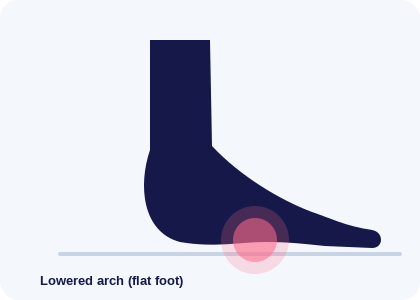
'Flat feet' describes a foot where the arch sits low or flattens a lot when you stand. 'Overpronation' is a term often used for a foot that rolls in more than average while walking or running. Both are very common, and on their own they are not a diagnosis of a problem.
When flat feet are usually not a concern
- You have always had flat feet and they don't hurt.
- Both feet look similar.
- You can rise onto your toes and the arch appears.
- You are active without pain.
When flat feet may be linked to pain
A lower or more mobile arch can increase load on some structures. People with flat feet who develop symptoms most often report:
- Arch or plantar heel pain, especially after long periods standing
- Pain along the inside of the ankle
- Shin pain with running or walking
- Tired, aching feet by the end of the day
- Knee pain that seems to relate to activity
A flat foot that has changed recently is different. If one arch has dropped over months, especially with pain or swelling on the inside of the ankle, it should be assessed. This can be a sign of a tendon problem that needs earlier management.
What an assessment looks at
- How your foot moves when you stand, walk and, if relevant, run
- Strength of the calf and the muscles supporting the arch
- Joint flexibility in the foot and ankle
- Your footwear and how it wears
- Your activity levels and goals
Flexible vs rigid flat feet
A flexible flat foot has an arch when you're sitting or standing on your toes, but it flattens when you stand. This is the most common type. A rigid flat foot stays flat whatever position it's in. Rigid flat feet are less common and are more likely to need assessment, as they can relate to joint changes or bones that are joined together.
A simple check at home
- Stand barefoot and look at your arches in a mirror.
- Rise up onto your toes. Does an arch appear?
- Try a single-leg heel raise on each side. Is one much harder than the other?
An arch that appears on tiptoes and equal strength on both sides are reassuring signs. Difficulty with a single-leg heel raise on one side, especially with inner ankle pain, is a reason to book an assessment.
Footwear tips for flat feet
- A firm heel counter that holds the heel upright
- Some structure through the middle of the shoe (it shouldn't fold in half)
- A removable insole if you use orthotics
- Replace shoes when the midsole looks compressed or tilted
Management options
Management depends on your symptoms rather than the shape of your foot. Options your podiatrist may discuss include:
- Strengthening exercises for the calf and foot muscles. See our strengthening page.
- Supportive footwear with a firm heel counter and structure through the midfoot.
- Custom foot orthoses to support the arch and reduce strain on painful structures.
- Activity planning to build up walking or running gradually.
If you have a child with flat feet, the approach is different. See our page on flat feet in children.
When to see a podiatrist
- One foot has become flatter than the other
- Pain or swelling on the inside of the ankle
- Arch or heel pain lasting more than a few weeks
- Difficulty rising up onto your toes on one leg
Could orthotics be part of your plan?
For people whose flat feet are linked to pain, custom orthotics are commonly used to support the arch alongside strengthening and footwear changes.
Orthotics aren't right for everyone. An assessment at our Bankstown clinic looks at your symptoms, foot function and footwear first, so any recommendation is based on your situation. We see patients from Bankstown and surrounding suburbs.
Frequently asked questions
Do flat feet need orthotics?
Not if they are pain-free. Orthotics are usually considered when flat feet are linked to symptoms.
Can exercises change flat feet?
Exercises won't usually change the shape of the arch, but they can improve strength and may reduce symptoms.
Important information
The information and exercises on this page are general in nature and are intended for educational purposes only. They are not a substitute for an individual assessment, diagnosis or treatment by a registered health practitioner. Not every exercise is suitable for every person. Please only complete these exercises as advised by your podiatrist or another registered health practitioner who has assessed you. Outcomes vary between individuals and no particular result can be guaranteed. If you are unsure whether an exercise is right for you, or your symptoms change or worsen, stop the exercise and seek advice from a health practitioner. In an emergency, call 000.
This article was prepared by Dr Bilal Khelladi, a podiatrist registered with the Podiatry Board of Australia. Dr Khelladi is not a registered medical practitioner. Published November 2026.
References
- Hawke F, Burns J, Radford JA, du Toit V. Custom-made foot orthoses for the treatment of foot pain. Cochrane Database Syst Rev. 2008;(3):CD006801.